Five of Swords upright meaning
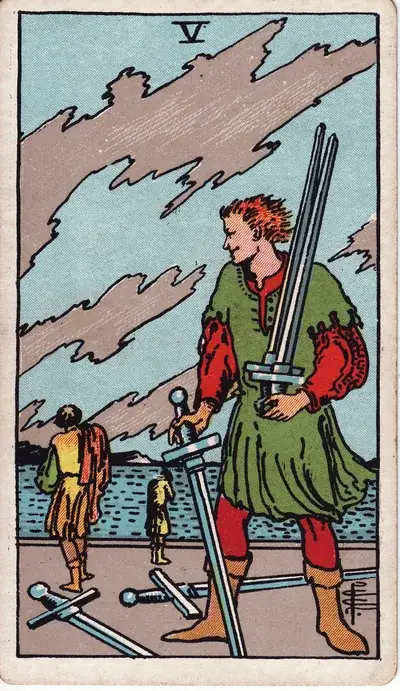
The Five of Swords shows a figure gathering blades while others walk away defeated. It's the card of hollow victory — winning the argument but losing goodwill, or standing your ground at a cost you'll feel later. Tension and ego crackle through it.
Its question is pointed: is being right worth what it takes? Sometimes you must fight; often the wiser move is to lower the sword. Notice whether the win in front of you is worth the bridge it burns.
Five of Swords reversed meaning
Reversed, the Five of Swords softens toward repair. It can mean reconciliation, making amends after a falling-out, or the willingness to release a grudge you've carried too long. The fight is winding down.
Spiritually, it invites you to choose peace over the need to win. Forgiveness — offered or received: clears heavy air. It can also mean finally walking away from a conflict that was never going to end well.
Five of Swords in love
In love, the Five of Swords warns of arguments where winning matters more than understanding. Point-scoring, cold words, or the urge to have the last say can quietly erode a bond, even when you're technically right.
The constructive path is to drop the scorecard. Ask what you actually want, to win, or to be close. Softening first often does more than any perfectly aimed argument ever could.
Five of Swords in career & money
At work, the Five of Swords flags conflict, rivalry, or a win that leaves resentment behind. You might come out on top of a dispute yet damage relationships you'll need again. Watch for cutthroat energy, yours or others'.
Financially, it cautions against victories built on someone else's loss. Aim for outcomes that hold up over time rather than short-term wins that sour. Fair deals age better than clever ones.
Five of Swords: yes or no?
As a yes/no card, the Five of Swords leans no. Even where you 'win', the cost tends to outweigh the gain, so it rarely signals a clean, satisfying outcome.
If pursuing this means conflict and burnt bridges, the card suggests it isn't worth it. Consider whether stepping back would serve you better than pressing on.
Five of Swords card combinations
With the Six of Swords: the natural sequel, withdrawal after a conflict that wasn't worth winning. With the Seven of Swords: winning by means you'd rather not describe; two cards about hollow victories.
With the Five of Wands: a disagreement that stops being fair; someone starts playing to win. With Justice: a conflict heading toward formal consequences, often literal. With the Three of Cups: a falling-out inside a close group, which is where this card does the most damage.
With Temperance: the antidote, de-escalation available if someone is willing to go first. With the Tower: a fight that brings down more than either side intended.
When the Five of Swords appears in a reading
In a past position the Five of Swords usually points at a conflict you won or lost badly, and the residue tends to be the reason the current question exists. In the present it describes a fight where the cost is exceeding the prize, whichever side you're on. In a future position it warns of conflict with no good outcome available.
As advice, this card asks whether winning this would actually help. It's one of the deck's clearest arguments for walking away, and it treats the desire to be proved right as the thing doing the damage.
On timing, the Five of Swords is fast, days to weeks. Conflict moves quickly, and this one is usually already underway.
Frequently asked questions
What does the Five of Swords mean with the Six of Swords?
The natural sequel: withdrawal after a conflict that wasn't worth winning. Leaving is the resolution the Five doesn't offer.
What is the timing of the Five of Swords?
Fast: days to weeks. Conflict moves quickly, and what this card describes is usually already underway.
Is the Five of Swords a bad card?
It's challenging. It points to conflict and hollow victory, winning at a cost. Its lesson is to weigh whether being right is worth the damage.
What does the Five of Swords mean in love?
Arguments where winning outweighs understanding. Drop the scorecard and ask whether you want to win or to stay close.
What does the Five of Swords reversed mean?
Reconciliation and making amends, releasing a grudge, or walking away from a fight that can't end well.
Is the Five of Swords a yes or no card?
Generally no: even a win here costs more than it gains. Consider whether stepping back would serve you better.
Does the Five of Swords mean I'll lose?
Not necessarily. You may even win. But the card warns the victory could be hollow, leaving resentment or lost goodwill behind.