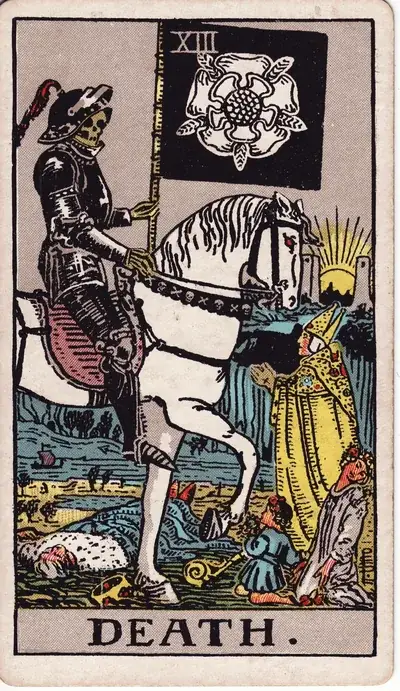
Death upright meaning
Despite its stark name, Death is one of the tarot's most hopeful cards. It almost never means physical death. It represents transformation: the ending of one chapter so a new one can begin. Upright, it signals profound change and the shedding of what no longer serves you.
When Death appears, something is ready to be released, a phase, a habit, an old identity. It can feel bittersweet, but it makes room for renewal. Every ending here is a doorway to rebirth.
Death reversed meaning
Reversed, Death often means resisting a necessary change, clinging to something that's already over, or fearing the transformation you know is coming. The ending is delayed, and with it the fresh start it would bring.
It can also reflect being stuck in a painful in-between, unable to fully let go. The card gently urges you to release your grip; only then can the new chapter you're waiting for begin.
Death in love
In love, Death signals transformation rather than loss. A relationship may be evolving into a new phase, shedding old patterns, or reaching a natural turning point. For some it marks an ending that ultimately frees both people; for others, a profound renewal of the bond.
Reversed, it can flag holding onto a relationship past its time, or fearing the change that would let love grow. Letting go, where needed, opens space for something truer.
Death in career & money
At work, Death marks the end of one path and the beginning of another, a career change, the close of a project, or a role you're outgrowing. Though endings can feel unsettling, they clear the way for meaningful new direction.
Financially, it may signal a significant shift in circumstances. Releasing old approaches and adapting to the new is what carries you forward.
Death: yes or no?
As a yes/no card, Death leans no to keeping things as they are, but a yes to transformation and moving on. It signals that change is the answer.
If you're asking whether something should end or evolve, Death says yes. If you're hoping the current situation will simply continue, it points toward release instead.
Death card combinations
With the Tower: change from two directions at once; the ending is both sudden and structural, and there's no version where things go back. With the World: an ending that genuinely completes rather than just stops.
With the Eight of Cups: a departure you chose meeting an ending that was coming anyway. With the Hanged Man: the pause before transformation; suspension resolving into a real change. With Temperance: transition handled well: change absorbed rather than resisted, one of the gentler readings of this card.
With the Ace of Wands: the new thing already visible on the other side of the ending. With the Four of Pentacles: a difficult pairing, inevitable change met with a grip that won't loosen.
When Death appears in a reading
In a past position Death marks an ending you can date, and it usually surfaces because the present question is downstream of it. In the present it says something is finishing now, and that the effort to preserve it is what's costing you. In a future position it promises transformation, readers are near-unanimous that it describes change rather than mortality.
As advice, Death is one of the deck's most consistent cards: let it end. It doesn't argue that what's finishing was bad, only that it's over, and it treats the attempt to negotiate as the source of the pain rather than the ending itself.
On timing, Death is moderate to slow, months. The change is inevitable rather than immediate, and it usually completes later than the querent expects.
Frequently asked questions
What does the Death card mean with Temperance?
Transition handled well: change absorbed rather than resisted. It's one of the gentler readings the Death card gets.
What is the timing of the Death card?
Moderate to slow: months. The change is inevitable rather than immediate, and usually completes later than expected.
Does the Death card mean someone will die?
No. Death almost never means literal death. It symbolises transformation, endings, and rebirth: the close of one chapter and the start of another.
What does Death mean in love?
Transformation rather than loss. A relationship may enter a new phase, shed old patterns, or reach a freeing turning point.
What does Death reversed mean?
Resistance to change, clinging to what's over, or a transition that's stalled and needs release.
Is Death a yes or no card?
It's no to keeping things the same, but yes to transformation. Change is the answer it points toward.
What zodiac sign is the Death card?
Death is associated with Scorpio: the sign of deep transformation, rebirth, and profound change.